
Resilience needs strategy – security as a management responsibility
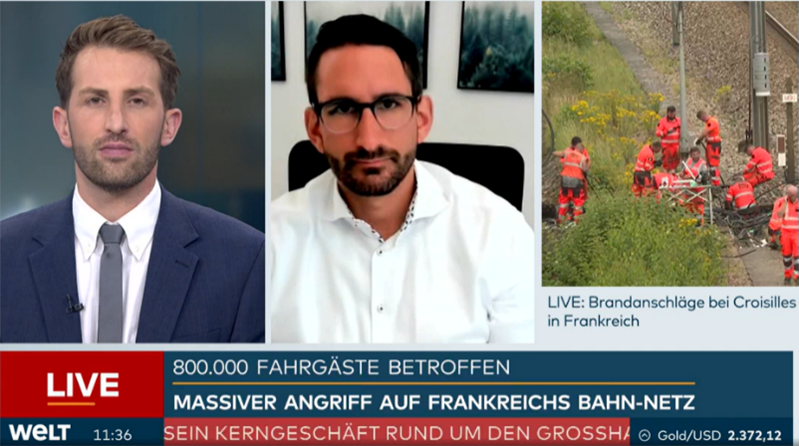
Sabotage, failures, crises: Companies are increasingly confronted with targeted disruptions and complex security threats. The question is no longer whether, but when processes will be interrupted or targeted. In several interviews with WELT TV, Stefan Erdweg, CEO of 3-core GmbH, explains how modern security concepts, business continuity management (BCM) and crisis management help companies from all industries to avoid failures and remain operational.
Understanding threats and reacting correctly
In the interviews with WELT TV, Erdweg emphasises that sabotage is one of the real threats that companies have to deal with nowadays, regardless of industry or size. Whether through arson , attacks on technical equipment or targeted disruptions – the effects are often immediate and significant. Production downtimes, logistics failures, delivery delays, financial losses or reputational damage are no longer theoretical risks, but actual scenarios.
It is crucial to consider sabotage not in isolation, but as part of a comprehensive system of resilience. Companies do not need isolated solutions, but integrated security concepts that identify potential weak points and secure them preventively.
Security solutions that stand the test of time – strategic, legally compliant and future-proof
Today, targeted attacks, sabotage and failures jeopardise not only individual companies, but also entire supply chains and public systems. The European Union is also aware of this reality: directives such as NIS2 and the KRITIS umbrella act are significantly increasing the requirements for companies in a wide range of sectors. Not only technical protective measures are required, but also comprehensive, documented strategies for physical security, business continuity management (BCM) and crisis management.
3-core supports companies in fulfilling these requirements and implementing them in effective, practicable security solutions. We develop integrated concepts that combine preventive protection, structured emergency planning and resilient crisis organisation – tailored to operational processes, official requirements and economic realities. After all, resilience is not created through individual measures, but through systematic thinking, forward-looking management and reliable implementation partners.