Security Management for Organisations
Identify security risks, organise protection and verify effectiveness
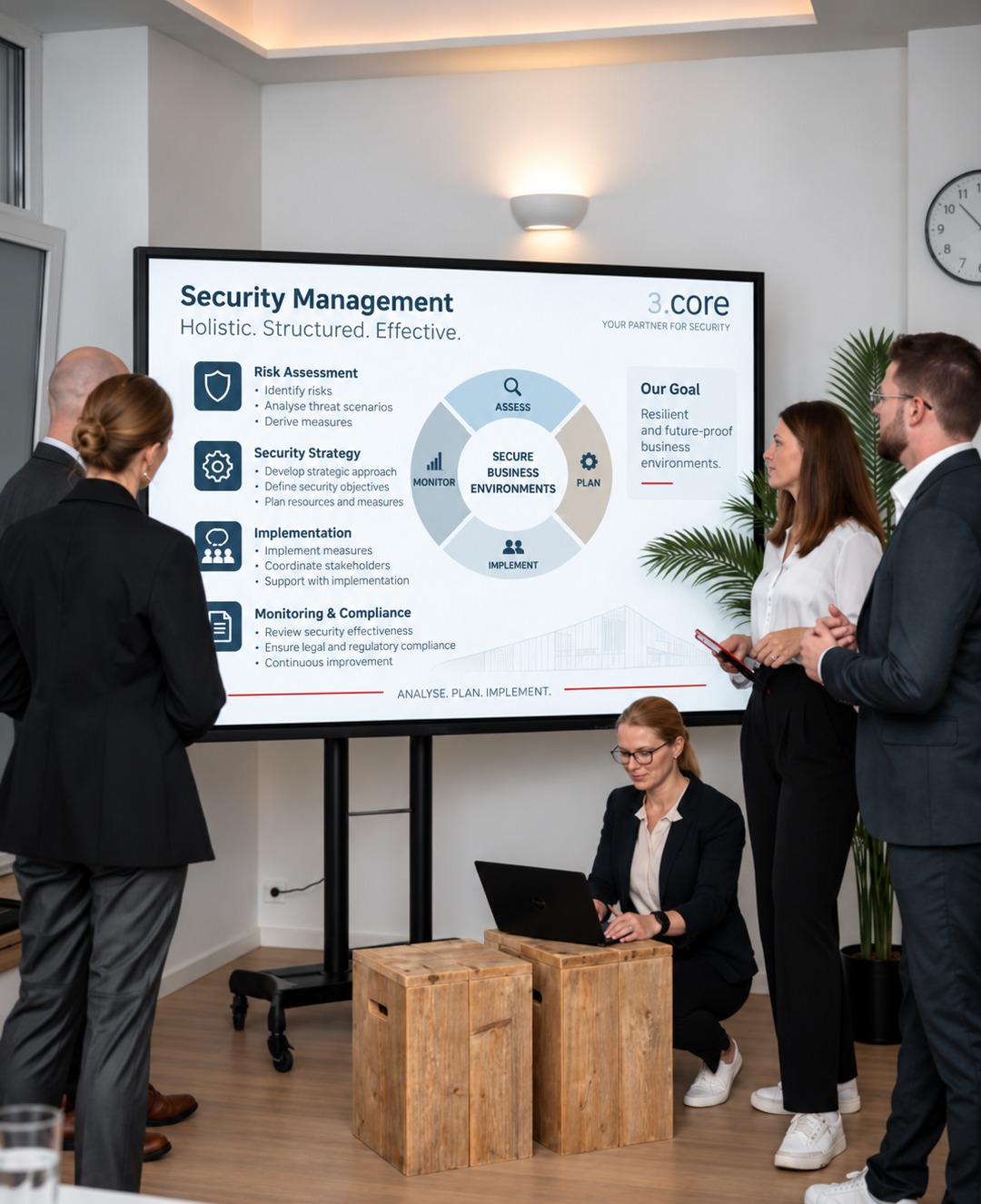
Security management provides the organisational framework that enables organisations to identify, assess and manage security risks systematically. It combines clear accountability with security risk assessments, Site Security Plans, proportionate controls, exercises and regular assurance of effectiveness.
This page provides a structured overview of the core components of security management, its interfaces with information security, Business Continuity Management and emergency and crisis management, and the specialist services provided by 3-core.
UNDERSTAND
ASSESS
PROTECT
IMPROVE
What is security management?
Security management is the systematic planning, direction and control of security within an organisation. It does not begin with individual products or technical measures. It begins with the organisation’s objectives, the people, sites, assets, information, processes and services that require protection, and the risks that could prevent those objectives from being achieved.
From this, organisations build a coherent system of security strategy, governance, risk assessment, Site Security Plans, operational processes, awareness and assurance. Security professionals prepare assessments and decisions; the relevant risk and asset owners must support priorities, resources and the acceptance of residual risk at the appropriate level.
Depending on the organisation, the security function may include physical security, personnel and organisational security, information protection, travel security, integrity and other corporate security topics. Information security, Business Continuity Management and emergency and crisis management remain distinct disciplines, but their interfaces should be aligned.
The core components of security management
Effective security management is built from several connected components. If one is missing, controls often remain isolated or cannot be managed and evidenced consistently at senior-management level.
Security strategy and governance
Security objectives, scope, roles and decision-making routes set the direction. Governance defines who assesses risk, approves measures, prioritises budgets, accepts residual risk and reports material developments to senior management.
Assets, threats and risks
Organisations need to understand which people, sites, facilities, information, processes and services matter most to their objectives. Threats, vulnerabilities and potential impacts are then analysed and assessed using consistent criteria
Site Security Plans and protective measures
Security objectives and coordinated protective measures are derived from the risk picture. Depending on the security requirements, this can include physical, technical, organisational and personnel controls, together with clear arrangements for access, detection, alerting, escalation and response.
Awareness, assurance and improvement
Protective measures are only effective when responsible teams and employees understand their roles and processes work in day-to-day operations. Training, communication, inspections, exercises, audits, incident reviews and authorised testing provide evidence for continual improvement.
The security management process
This is not a one-off project. The process should be repeated whenever organisational objectives, sites, security requirements, the threat environment, dependencies or applicable requirements change.

Our security management services
3-core supports organisations from strategic direction and governance through to the development, testing and improvement of practical security arrangements. Each specialist service page covers a clearly defined area in more detail.

Site Security Plans
We develop risk-based Site Security Plans for sites, facilities and projects. This includes asset and security requirements assessment, security risk assessment, security objectives and coordinated physical, technical, organisational and personnel measures.

Risk Governance
We support security strategy, roles, governance forums, risk criteria, risk acceptance, escalation routes and management reporting so that security decisions are taken transparently and at the right level.

Physical Security Awareness Training
We develop communication, workshop and learning formats that make security requirements understandable and embed security-conscious behaviour in day-to-day work.

International Protection and Travel Security
We support security situation assessments, protection strategies, travel security processes and the preparation of employees for international travel and projects.

Investigations, Forensics and Integrity
We support structured fact-finding in cases such as compliance breaches, fraud, theft, sabotage and other internal security incidents.

Family Office Security
We combine physical security, travel security, service-provider controls and emergency and crisis preparedness for Family Offices and entrepreneurial families.

Physical Penetration Testing
In authorised and clearly defined scenarios, we test how access management, technical controls, security guarding, reporting routes and security awareness work together in practice.

ISO/IEC 27001 Audits and Pre-Audits
We assess whether an Information Security Management System (ISMS) has been established, implemented and continually improved in a traceable and effective manner within the agreed scope. Formal certification decisions remain the responsibility of an independent certification body.
What effective security management looks like
Policies and plans alone do not create an effective security function. What matters is whether risks, accountability and protective measures can be managed, evidenced and reviewed in day-to-day operations.
- Clear objectives: Security objectives and scopes are derived from organisational objectives.
- Clear accountability: Roles, delegated authority, deputies and escalation routes are defined.
- Consistent risk logic: Security risks are assessed and prioritised using consistent criteria.
- Traceable decisions: Measures, budgets and accepted residual risks are documented.
- Coordinated controls: Physical, technical, organisational and personnel measures work together.
- Effective interfaces: Corporate Security, the ISMS, BCM and emergency and crisis management are coordinated.
- Regular assurance: Exercises, audits, tests and incident reviews lead to specific improvements.
Security management within Corporate Resilience
The security function is a core component of Corporate Resilience. Its preventive and governance activities should be coordinated with the disciplines that protect information, prepare for business disruption and manage serious incidents.
Business Continuity Management
Corporate Security reduces risks to people, sites, facilities and other assets. Business Continuity Management prepares the organisation to continue or recover time-critical products, services and business processes when a disruption occurs.
NIS2 and KRITIS
Depending on scope and applicability, organisations may face additional requirements relating to physical resilience and to cyber and information security. Corporate Security, the ISMS, BCM and emergency and crisis management should therefore be coordinated rather than developed as isolated programmes.
Emergency and Crisis Management
If a serious incident occurs despite preventive measures, emergency response arrangements and the Crisis Management Team organise operational and strategic response. Common alerting, escalation and communication routes connect preventive security with incident response.
Frameworks and requirements
There is no universal catalogue of security measures that is appropriate for every organisation. Recognised frameworks can, however, help organisations manage risks systematically and connect existing management systems in a coherent way.
ISO 31000 provides principles and guidance for risk management. The ASIS Enterprise Security Risk Management (ESRM) approach connects the security function with organisational strategy, asset owners and risk-based decision-making. ISO 22340:2024 provides current international guidance for an enterprise protective security architecture across security governance, personnel security, information security, cybersecurity and physical security. For information security, ISO/IEC 27001:2022 defines requirements for an ISMS.
Where applicable, legal and regulatory requirements must also be considered. In Germany, the KRITIS Umbrella Act addresses the physical resilience of critical installations. The German BSI Act (BSIG) contains cyber and information security risk-management requirements for important and particularly important entities. The requirements that apply in a specific case must be assessed for the organisation concerned.
Security management in practice
The security framework must reflect the organisation, its sites and its risk profile. The following projects illustrate how risk assessment, security zoning, physical effectiveness testing and cross-site security standards can be brought together in practice.
Security Strategy and Security Zoning
Physical Penetration Testing at a Campus Site
Cross-Site Standards for Physical Security
Frequently asked questions about security management
Security management is the ongoing organisational framework for objectives, accountability, risks, measures and assurance. A Site Security Plan describes, for a defined scope, the relevant risks, security objectives and how the required protective measures are intended to work together.
Typical responsibilities include security strategy and governance, asset and security requirements assessment, security risk assessment, the development and management of Site Security Plans, service-provider and action management, awareness, assurance activities, exercises, audits and continual improvement.
Information security is a distinct management discipline with close interfaces to Corporate Security. Roles, risk criteria, personnel and physical controls, incident management and evidence should be coordinated. A physical Site Security Plan does not replace an ISMS, and an ISMS does not automatically cover the full scope of physical and organisational security.
A sensible starting point is to clarify scope, objectives, critical assets and responsibilities. Existing structures and risks can then be assessed, a target operating model defined and prioritised actions assigned to owners with realistic deadlines.
Suitable methods include inspections, performance indicators, exercises, audits, incident reviews and authorised penetration testing. The method should fit the protective function being tested. Findings should have clear priorities, owners, deadlines and documented follow-up.
Senior management sets objectives and boundary conditions, provides appropriate resources and ensures clear accountability. Material security risks, priorities and residual risks should be addressed transparently at the appropriate decision-making level.
Structured security management is relevant to organisations that need to protect people, sites, facilities, information, projects or time-critical services. The level of formalisation should reflect security requirements, risk exposure, organisational size, business model and applicable obligations.
Develop your security management systematically
Would you like to assess your security function, enhance existing plans or verify the effectiveness of your protective measures? In a free, no-obligation kick-off call, we discuss your current position, the most important areas for action and the most appropriate starting point.