
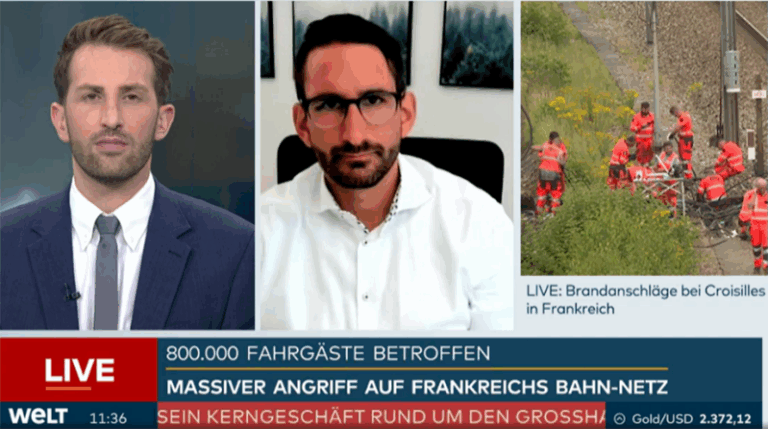
3-core in an interview with WELT TV: Public security under pressure

Public security is increasingly under pressure because the threat landscape is intensifying noticeably and disruptions are becoming more complex. Targeted attacks, sabotage, and failures of technical systems are no longer exceptional cases. The consequences often extend beyond an organization’s own operations and affect supply, mobility, and trust. In an interview with WELT TV, Stefan Erdweg, Managing Director of 3-core GmbH, explains why resilience must be managed strategically today and how security concepts, business continuity management, and crisis management help organizations remain capable of acting.

System outages with consequences for public security

The events in France have shown how vulnerable highly interconnected systems are. The arson attacks on the rail network not only had operational impacts on rail services, but also led to delays, diversions, and cascading effects across mobility and supply. Incidents like these make it clear that public security also depends on how well critical processes are protected and how quickly organizations can remain able to act at key interfaces. That is why a resilience strategy is essential, one that brings prevention, crisis organization, and recovery and restart together, instead of placing individual measures side by side.

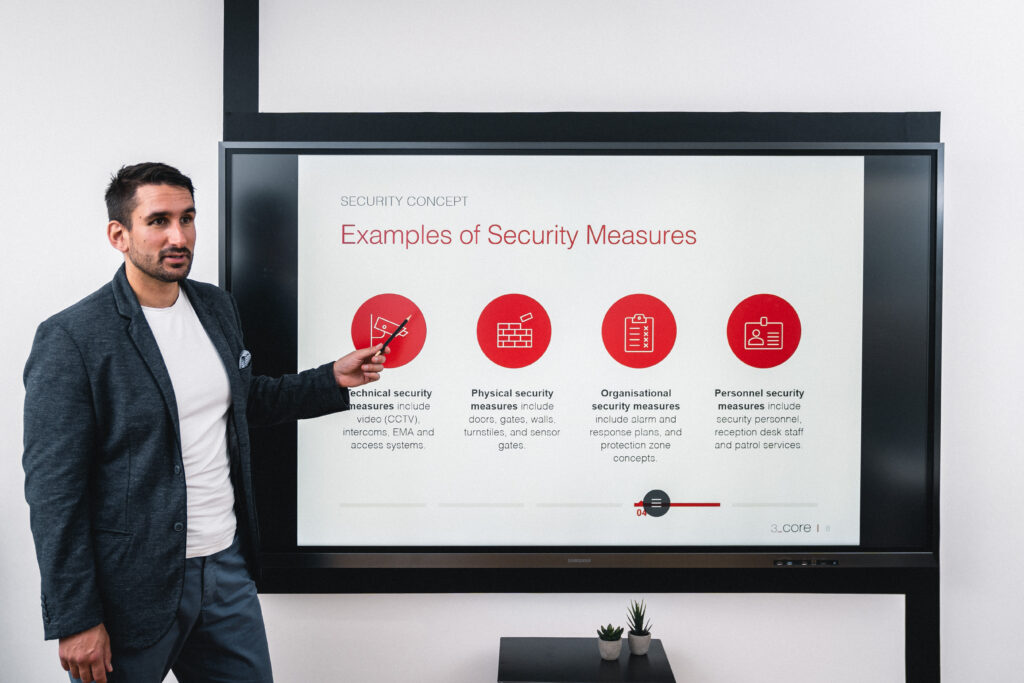
A man in a suit points to a large screen displaying a slide titled Examples of Security Measures, showcasing icons and descriptions for technical, physical, organizational, and personnel security management solutions.

Public security affects companies

Public security is often seen as the responsibility of authorities. In practice, however, it depends just as much on how reliably companies deliver their services and how quickly they can manage disruptions. As soon as energy, transport, IT, production, or municipal services are affected, there are immediate impacts on customers, partners, and often entire supply chains. Typical consequences in such situations include production downtime, delivery delays, service outages, financial losses, and a loss of trust that can only be rebuilt slowly. Public security therefore becomes a question of whether organizations assess risks realistically, put effective precautions in place, and respond in a structured way when an incident occurs.

Understanding threats and securing systems systematically

The interviews make it clear that companies should not view disruptions in isolation. Individual protective measures only work when they are embedded in an overall system. What matters is identifying vulnerabilities early, clarifying responsibilities, and planning measures so that they work in everyday operations and do not fail at interfaces in an emergency.

Three points emerge particularly often in implementation as critical success factors:

  1. There needs to be clarity about which processes are truly critical and which dependencies sit behind them.
  2. The organization must remain able to make decisions during an incident, even when information is incomplete and time pressure increases.
  3. Effectiveness only becomes robust when it is documented, verified, and improved on a regular basis.

Building blocks for resilience in the context of public security:

Physical security as a foundation of public security

Public security starts at sites, facilities, and critical interfaces. Physical security is effective when protection objectives are clearly defined and protective measures are integrated into operations, facility management, and the governance of service providers. This includes clear access rules, zoning logic, detection, and defined response paths that are backed by the organization.

Crisis management for situational awareness, decision making, and communication

When disruptions occur, it is not only speed that matters, but leadership and structure. Crisis management ensures that a shared situational picture is established, decisions are made in a traceable way, and internal and external communication works in a coordinated manner. Especially at the interfaces between operations, IT, communications, service providers, and external stakeholders, it becomes clear whether roles, approvals, and escalation work or whether time is lost. In moments like these, it becomes clear how well public security is organizationally secured.

Business continuity management for emergency operations and restart

To prevent services from failing for an extended period, you need robust emergency operations and a structured restart. Business continuity management translates risks into practical capability to act and defines what must continue, which minimum service levels are possible, and how the restart is implemented in practice.

Verifiability becomes a permanent part of public security

Beyond actual effectiveness, verifiability is becoming increasingly important. Organizations must be able to demonstrate how risks are assessed, measures are prioritized, and improvements are implemented. Clear documentation, regular reviews, and tests and exercises make resilience auditable and continuously improvable, which is also relevant for stakeholders and auditing bodies. This ensures that public security is not only planned, but made robust and sustainable over time.

How we support public security as 3-core as an implementation partner

We support companies as an implementation partner in building security concepts so that prevention, response, and recovery and restart work together and actually function in operations. This is not about paper concepts, but about clear responsibilities, practical processes, and verifiability that is considered from the outset. Together, we develop and implement integrated solutions for physical security, crisis organization, and business continuity management so that companies can deliver their services reliably even under disruptions and sustainably strengthen public security.


Steps for public security

Public security cannot be achieved in interconnected structures through individual measures. What matters is that physical security, clear responsibilities, and robust procedures work together in a way that functions in everyday operations and takes effect immediately in an incident. In practice, the following steps have proven effective:

  1. Critical sites, facilities, and access points are prioritized so that physical security focuses on where failures would have the greatest impact on public security.
  2. Physical security vulnerabilities are assessed on site so that access, perimeters, technical rooms, and interfaces with service providers do not become blind spots.
  3. Access and vehicle entry processes are clearly defined so that permissions, visitors, key management, and contractors remain practical in operations.
  4. Detection, alerting, and escalation are clearly defined so that a physical incident is recognized, assessed, and handled in a structured way quickly.
  5. Emergency and recovery and restart plans are backed by resources so that there is no need to improvise after a disruption and public security can be stabilized faster.
  6. Tests and exercises are carried out regularly so that measures, roles, and procedures actually work in an emergency.
A construction worker wearing a helmet and high-visibility jacket stands on a concrete block beside a metal fence, appearing to inspect or work on the fence near a blue building as part of security management measures.

Explore more: Projects & other articles