
1) BCMS set-up and involvement of the business units
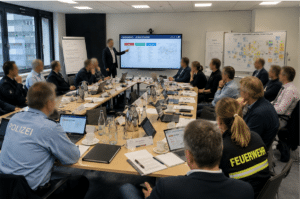
To begin with, the objectives, scope and approach were agreed upon, and the involvement of the business units was organised. The interviews served not only to map out processes, but above all to systematically identify dependencies, bottlenecks and external interfaces.
The interviews focused on, amongst other things:
- Process chains and interfaces (including external partners/service providers)
- Resources and bottlenecks (staff, IT, locations, data flows)
- Contingency operational assumptions (what is realistically achievable in the event of a disruption)
2) Business Impact Analysis (BIA) and Risk Analysis
In the next step, criticality, tolerable downtime and recovery requirements were assessed for each process. At the same time, relevant risks were evaluated in order to consistently derive priorities and the need for action. For Track and Trace, this involved specifically defining the minimum functionality required during emergency operations and determining the point at which a failure becomes critical from both an economic and regulatory perspective.
In brief:
- BIA clarifies impacts and time sensitivity (what needs to be up and running again, and how quickly).
- Risk analysis assesses threats and vulnerabilities (what could realistically occur and how severe the impact would be).
- The following, amongst other things, were derived from the BIA: Emergency operation objectives and minimum performance (to ensure that Track and Trace remains verifiable)
- Restart objectives (e.g. time/data requirements) and priorities for restarting
critical dependencies that directly affect track-and-trace capability
3) Deriving and coordinating continuity strategies
Based on the analysis, appropriate continuity strategies were developed – with a focus on emergency operations, recovery and feasibility in day-to-day business (including external partners). In doing so, it was determined which measures would have the greatest impact on maintaining stable delivery capability and track-and-trace documentation, even in the event of disruptions.
4) Tool-supported documentation and training
The 3-core BCM tool was utilised, which maps the work steps in line with BSI Standards 200-4 and 200-3, from process mapping through BIA and risk analysis to the development of continuity strategies. Content was recorded and evaluated directly within the tool, and refined iteratively in collaboration with the specialist departments. In addition, staff received targeted support and training to ensure that the operational implementation of BCM is firmly embedded within the organisation and that the results can be incorporated into the BCM cycle.