
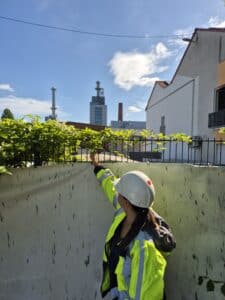
A person wearing high-visibility clothing is working on a metal fence that forms part of a Security Zone. In the background, a facility operated by an Energy Producer is visible.

Security Plan for an Energy Producer

 As an Energy Producer, the client faced the challenge of translating the parent company’s global security requirements into a robust security framework that could be applied locally. 3-core GmbH supported the development of a Security Plan for the German Business Unit based on the international Physical and Personal Security Standard, including a threat actor profile analysis, a defined roles and responsibilities model, and a RACI matrix.

International Requirements, Local Implementation

The client is part of an international energy company and is one of Germany’s leading oil and gas producers. Against the backdrop of volatile energy markets, geopolitical tensions, and increasing requirements for operators of critical facilities, the physical protection of production sites and the security of personnel are becoming increasingly important.

The parent company had established group-wide requirements for physical and personnel security. The challenge was not merely to adopt these international requirements formally, but to translate them into a practical and locally applicable framework for the German Business Unit.

For the Energy Producer, this meant translating the standard into clearly defined roles, processes, security requirements, and responsibilities.

From Corporate Security Standard to Security Plan

The Security Plan was developed as the overarching physical and personnel security framework for the German Business Unit. The objective was to establish a scalable blueprint that could be applied across different sites and facilities while accommodating site-specific conditions, operational requirements, and local threat exposure.

The project focused on three key questions:

  • Which requirements of the parent company’s corporate security standard apply to the German Business Unit?
  • Which threat actor profiles, threat scenarios, and security risks are relevant to its sites and facilities?
  • Who is Responsible, Accountable, Consulted, and Informed with regard to implementation, decision-making, and ongoing security governance?

The result was a structured security governance framework that translates corporate requirements into clearly defined roles, responsibilities, processes, and locally implementable security measures.

Threat Actor Profiles as the Basis of the Protection Strategy

As an Energy Producer, the client must consider a range of threat scenarios, from opportunistic acts to targeted attacks against critical infrastructure. The Security Plan therefore assessed a number of relevant threat actor profiles.

This analysis ensured that security measures were not defined generically, but aligned with realistic threats and site-specific risks. It provided the basis for defining requirements relating to prevention, detection, intrusion delay, response, documentation, and security governance.

RACI Matrix: Clear Accountability within International Structures

A key component of the Security Plan was the development of a RACI matrix. It ensures that security requirements are not only defined, but also assigned to clearly accountable roles. For each task, the matrix specifies who is Responsible for execution, who is Accountable for the decision and outcome, who must be Consulted for subject-matter input, and who must be Informed.

RACI stands for:

  • Responsible: responsible for carrying out the task,
  • Accountable: ultimately accountable for the decision and outcome,
  • Consulted: consulted for subject-matter expertise,
  • Informed: kept informed.

This clarity is particularly important in international organizations. It prevents responsibilities from remaining unclear between the corporate group, the Business Unit, site operations, and specialist functions.

Eine RACI-Matrix zeigt die Aufgabenverteilung rund um einen Energieerzeuger. Oben sind vier verantwortliche Personengruppen dargestellt, links mehrere Aufgabenlisten. Die Buchstaben R, A, C und I markieren, wer für die jeweiligen Aufgaben verantwortlich, rechenschaftspflichtig, beratend oder zu informieren ist.

Blueprint for the Entire Business Unit

The Security Plan was not developed as a stand-alone solution for a single site. It serves as a scalable blueprint for the entire German Business Unit.

The key benefit lies in standardization: sites can be assessed consistently, security measures can be planned in a transparent and traceable manner, and responsibilities can be governed more clearly. At the same time, the plan remains sufficiently flexible to accommodate local threat exposure, site-specific characteristics, and operational requirements.

For an Energy Producer with multiple sites, achieving this balance is essential: a consistent security framework that can be adapted to different local operating environments.

Outcome: From Global Standard to Local Security Governance

The result was a Security Plan that translated the parent company’s global requirements into a practical implementation framework for the German Business Unit.

The Energy Producer received:

  • an overarching security governance framework,
  • a consistent approach to physical and personnel security,
  • a risk analysis of relevant threat actor profiles and associated scenarios,
  • a RACI matrix establishing clear roles and accountabilities,
  • a framework for site-specific implementation,
  • guidance in the context of critical infrastructure requirements and NIS2.

The key added value was the transformation of an international corporate standard into a locally applicable implementation framework—clear, manageable, and scalable across additional sites. This enables the oil and gas producer not only to document physical security requirements, but also to govern and manage them proactively.

Our Services for the Project

Analysis of the International Corporate Security Standard

The 3-core GmbH analyzed the group-wide standard for physical and personnel security and translated its requirements into a structured framework suitable for application within the German Business Unit.
Development of the Security Plan

The 3-core team developed a Security Plan as an overarching blueprint for physical and personnel security across the Business Unit.

Assessment of Risks Associated with Relevant Threat Actor Profiles

The 3-core GmbH assessed a range of threat actor profiles and derived corresponding requirements for prevention, detection, intrusion delay, response, and security governance.

Development of the RACI Matrix

The 3-core team developed a RACI framework to clearly allocate tasks, decision-making authority, and information responsibilities among the VP HSES, Site Management, VP Operations, Security Specialists, and employees.

Deployment Across the Business Unit

The 3-core team structured the Security Plan as a scalable framework for implementation across the entire German Business Unit.

Assessment of Regulatory Requirements

The 3-core team considered the critical infrastructure and NIS2 regulatory context and assessed the significance of physical and personnel security for the oil and gas producer.