


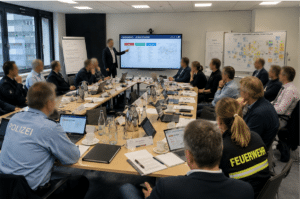
A woman pointing at a screen during a crisis management exercise, presenting key response strategies and coordination measures.

Security Requirements Analysis for a Municipal Utility

A Security Requirements Analysis enables municipal utility companies to plan physical security in a transparent, traceable, and risk-based manner rather than relying on subjective judgement. Our project showed that many security measures were already in place, but they had not consistently been derived from an overarching security concept.

Only by assessing protection requirements, criticality, security zones, and vulnerabilities did it become clear which sites, processes, and access points required priority protection.

From Legacy Security Arrangements to a Risk-Based Security Requirements Analysis

Our client, a municipal utility company, operates a wide range of site types. These include administrative and customer service facilities, water, gas, and electricity infrastructure, technical network nodes, and publicly accessible facilities.

This combination makes physical security particularly challenging. Some areas must remain accessible and customer-friendly, while others contain sensitive information, technical installations, or processes critical to the continuity of essential services. The sites are also accessed by service providers, external contractors, maintenance teams, visitors, and employees with different access requirements.

At the sites assessed during the project, a range of security measures was already in place. These included physical protection measures, locking and access systems, technical surveillance systems, and organizational procedures. However, most of these measures had evolved over time rather than being derived from a consistent, overarching security concept.

This resulted in a number of typical challenges:

  • security standards varied from one site to another,
  • public, semi-public, internal, and critical areas were not consistently separated,
  • access rights and key management processes were not always derived from the respective protection requirements,
  • structural vulnerabilities at access points were assessed inconsistently,
  • technical detection sometimes occurred only at a late stage,
  • responsibilities, alarm and notification procedures, and escalation processes were not documented consistently across all sites.

The core issue was therefore not the absence of security measures. Rather, there was no overarching benchmark against which those measures could be assessed. A Security Requirements Analysis provides precisely this benchmark.

A Security Requirements Analysis is a structured process used to determine the level of protection required for specific information, processes, rooms, buildings, facilities, or sites.

The central question is:

What level of harm could result if a specific asset were compromised?

The 3 Core Principles of a Security Requirements Analysis

A Security Requirements Analysis is based on three fundamental principles. They help ensure that security requirements are assessed not only from a technical perspective, but also in terms of potential harm and impact.

This integrated approach is particularly important for a municipal utility company, as sensitive information, technical facilities, and processes essential to the continuity of public services must all be protected simultaneously.

Confidentiality:
Information must be accessible only to authorized individuals. This includes, for example, site plans, key registers, operational data, alarm and notification procedures, customer data, and technical documentation.

Availability:
Essential facilities, systems, and processes must remain operational. This is particularly important for a municipal utility company, as disruptions may affect the continuity and security of supply.

Integrity:
Information, facilities, and processes must not be altered or manipulated without detection. For a municipal utility company, this can be particularly critical where technical systems, control information, or operational processes are affected.

A Security Requirements Analysis does not begin by asking which technical systems should be installed. It first determines what needs to be protected and which level of security is appropriate.

How the Security Requirements Analysis Was Implemented in the Project

To ensure that the case study was grounded in practice rather than remaining purely theoretical, the Security Requirements Analysis for the municipal utility company was combined with an on-site assessment. The key objective was not to evaluate the existing security measures in isolation, but to compare them with the actual protection requirements of the respective sites and areas.

Identifying Assets Requiring Protection

The first step in a Security Requirements Analysis is to identify the relevant assets requiring protection. For the municipal utility company, this included not only buildings and technical infrastructure, but also people, information, and operational processes.

Assessing the Impact of a Security Incident

The second step involved assessing the potential consequences of a security incident. The analysis was not limited to burglary or theft, but also considered tampering, sabotage, information leakage, business interruption, and risks to people. This linked the Security Requirements Analysis to specific damage scenarios.

Assessing the Impact of a Security Incident

In the second step, the potential consequences of a security incident were assessed. The analysis covered not only burglary and theft, but also manipulation, sabotage, information leakage, business interruption, and risks to people. This linked the Security Requirements Analysis to specific damage scenarios.

Deriving Security Zones

Security zones can be derived from the identified protection requirements. A security zoning concept ensures the clear separation of public, semi-public, internal, and critical areas.

The benefit is that access-control rules, physical separation, surveillance, and organizational requirements are integrated in a transparent and traceable manner.

Reviewing Existing Security Measures

The existing security measures were then compared with the identified protection requirements. The objective was not to classify individual measures in general terms as either adequate or inadequate. The decisive factor was whether they were appropriate for the protection requirements of the respective area.

Prioritizing Project Findings

The Security Requirements Analysis identified several specific areas for action. Rather than treating them as an extensive list of deficiencies, they were prioritized according to protection requirements, criticality, and implementation feasibility.

The practical value lay in clearly identifying which measures could deliver an immediate improvement and which should be planned as part of an overarching security concept.

Deriving Security Measures

Specific measures were defined only after completion of the Security Requirements Analysis. In this case study, they were grouped into three categories.

Physical measures: Enhancements to doors, windows, gates, technical openings, shafts, key safes, and security barriers.

Technical measures: Access control, detection systems, tamper-protected contacts, event verification, alarm transmission, and technical surveillance.

Organizational measures: Lock-up procedures, security patrols, key management, visitor procedures, contractor management, deficiency tracking, escalation pathways, maintenance, testing, and training.

The Outcome: Protection Requirements Become Transparent

The Security Requirements Analysis enabled the municipal utility company to restructure its approach to physical security.

Previously, numerous individual measures were in place. Following the analysis, a transparent and traceable relationship was established between protection requirements, security zones, security standards, responsibilities, alarm management, and the prioritization of measures.

The key added value was clarity:

  • Which sites are particularly critical?
  • Which areas require enhanced security?
  • Which measures must be implemented immediately?
  • Which measures can be implemented as part of a planned programme?
  • Which organizational processes must be defined as binding requirements?
  • Where will investment have the greatest impact?

This enabled the municipal utility company to transition from a historically evolved security structure to a risk-based level of security.

OUR SERVICES FOR THE SECURITY REQUIREMENTS ANALYSIS

Review and Analysis of Relevant Documentation

Our 3-core team systematically reviewed the municipal utility company’s existing documents, policies, and records. The review covered, among other aspects, existing security measures, access control procedures, key management processes, alarm and notification pathways, contractor procedures, and organizational responsibilities. The objective was to understand the existing security structure and compare it with the actual requirements of the different sites as part of the Security Requirements Analysis.
On-Site Assessment of Security-Relevant Locations

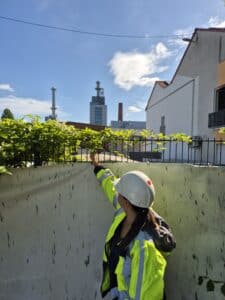
As part of the Security Requirements Analysis, selected municipal utility sites were inspected and assessed on site. Our security experts evaluated physical, technical, and organizational security measures, including doors, gates, windows, secondary access points, technical openings, key safes, access routes, and existing surveillance systems. This provided a realistic assessment of the sites’ actual security posture.

Assessment of Protection Requirements and Criticality

For the various sites, areas, facilities, and processes, the Security Requirements Analysis assessed the required level of protection and the potential impact of a security incident. Particular consideration was given to infrastructure relevant to the continuity of essential services, sensitive information, public accessibility, dependencies on external service providers, and operational processes. This provided a transparent basis for distinguishing between standard, enhanced, and particularly critical protection requirements.

Analysis of Security Zones and Access Structures

A key component of the Security Requirements Analysis was the assessment of the separation between public, semi-public, internal, and critical areas. Our team examined whether visitors, employees, service providers, and external contractors were routed, escorted, and documented in accordance with the applicable protection requirements. This identified the transition points at which additional physical, technical, or organizational security measures were required.

Identification and Prioritization of Vulnerabilities

Based on the site inspections and analyses, physical, technical, and organizational vulnerabilities were identified. These included, among other aspects, vulnerable access points, inadequately secured secondary entrances, exposed sensitive information, weaknesses in key management, and deficiencies in detection and alarm processes. The vulnerabilities were not assessed in isolation, but prioritized according to protection requirements, criticality, potential impact, and implementation feasibility as part of the Security Requirements Analysis.

Development of a Risk-Based Implementation Plan

Based on the findings of the Security Requirements Analysis, 3-core developed a structured implementation plan for the municipal utility company. The plan distinguished between immediate short-term measures, conceptual and organizational tasks, and medium- to long-term physical and technical upgrades.

This provided the client with a clear basis for deciding which measures should be implemented first and which areas required further strategic development.

Recommendations for Ongoing Security Operations

Finally, recommendations were developed for the continuous management and improvement of physical security. These included clearly defined responsibilities, regular security patrols, lock-up checks, inspection cycles, maintenance, training, deficiency tracking, and effectiveness reviews.

The objective was to ensure that the Security Requirements Analysis was not treated as a one-time assessment, but as the foundation for a continuous security management process.