

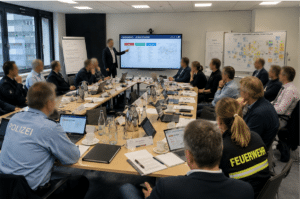
Meeting of an interdisciplinary emergency response team comprising representatives from the police, fire and rescue services, and other public authorities to coordinate a joint Emergency Response Plan.

Emergency Response Plan: Policy, Processes, and Exercises

When a critical incident occurs at a production site, it is not enough simply to have a plan in place. What matters is whether roles, decision-making, communication, and operational procedures function effectively at the decisive moment.

For a manufacturing company operating two sites, 3-core GmbH developed an Emergency Response Plan designed to strengthen precisely this operational readiness, from the development of a formal policy and the coordination of defined emergency scenarios through to a realistic emergency exercise.

Initial Situation: Two Sites, Multiple Dependencies

The costumer operates large production facilities at two different locations. Both sites are critical to ongoing operations, but differ in terms of processes, responsibilities, interfaces, and organizational dependencies. The existing emergency and crisis management framework therefore needed to be further developed and aligned more closely with the operational realities at each site.

3-core GmbH conducted site inspections at both locations, assessed the production environment, operational processes, and interfaces, and interviewed the relevant specialist departments. The process involved the functions typically found in a manufacturing company: production, engineering and maintenance, occupational safety and HSE, site management, plant security, logistics, IT/OT, quality management, communications, and the responsible leadership and decision-making roles.

This ensured that the emergency response processes were not developed in isolation, but based on actual operational procedures. The interviews helped to validate the available information, review assumptions, and prepare the exercise specifically around real interfaces, responsibilities, and decision-making pathways.

The Assignment: Turning Information into an Operationally Effective System

3-core GmbH was commissioned to transform the information gathered into a robust framework for emergency and crisis situations. The focus was on developing an Emergency Response Plan that not only defines roles and responsibilities, but also provides clear, practical guidance when an incident occurs.

The assignment comprised three components: a policy governing the organizational structure and operational procedures, standardized response processes for selected emergency scenarios, and an onboarding programme followed by a crisis management exercise. The objective was to transform existing individual pieces of information into a coordinated response framework with clearly defined roles, decision-making pathways, communication requirements, and interfaces.

Security Concept: From the Organizational Framework and Defined Emergency Response Processes to Practical Application in an Exercise

The Emergency Response Plan was deliberately designed with a strong practical focus. Its purpose was not merely to document what should be done in an emergency, but to prepare the organization to remain capable of acting effectively under time pressure.

Onboarding and Exercise: From Documentation to Practical Application

Following the development of the policy and response processes, the new structures were implemented within the organization. The onboarding programme provided participants with a clear understanding of how roles, escalation pathways, decision-making processes, and crisis communication interact during an emergency.

A realistic crisis management exercise was then conducted. It was based on the agreed scenarios and incorporated the procedures developed in the preceding stages. The objective was to apply the Emergency Response Plan under realistic conditions and assess whether roles, information flows, and decision-making processes functioned effectively as an integrated system.

Emergency Response Processes: Working Through Five Scenarios in Detail

Based on the site assessments and interviews with the relevant specialist departments, five emergency scenarios were selected jointly with the costumer. It was essential that the scenarios reflected the organization’s actual operating environment and represented different types of operational stress, such as failures of critical processes, disruptions to essential resources, restrictions affecting production areas, or incidents requiring a high degree of coordination.

For the Emergency Response Plan, the scenarios were translated into standardized response processes. 3-core GmbH defined the initiating events, initial assessment steps, escalation points, participating roles, information flows, interfaces, and decision-making pathways. This made it possible to show how an incident can be managed from the initial report through to a coordinated response, and which information must be available at the appropriate time.

Onboarding and Exercise: From Documentation to Practical Application

Following the development of the policy and response processes, the new structures were implemented within the organization. The onboarding programme provided participants with a clear understanding of how roles, escalation pathways, decision-making processes, and crisis communication interact during an emergency.

A realistic crisis management exercise was then conducted. It was based on the agreed scenarios and incorporated the procedures developed in the preceding stages. The objective was to apply the Emergency Response Plan under realistic conditions and assess whether roles, information flows, and decision-making processes functioned effectively as an integrated system.

Emergency Response Processes: Working Through Five Scenarios in Detail

Based on the site assessments and interviews with the relevant specialist departments, five emergency scenarios were selected jointly with the costumer. It was essential that the scenarios reflected the organization’s actual operating environment and represented different types of operational stress, such as failures of critical processes, disruptions to essential resources, restrictions affecting production areas, or incidents requiring a high degree of coordination.

For the Emergency Response Plan, the scenarios were translated into standardized response processes. 3-core GmbH defined the initiating events, initial assessment steps, escalation points, participating roles, information flows, interfaces, and decision-making pathways. This made it possible to show how an incident can be managed from the initial report through to a coordinated response, and which information must be available at the appropriate time.

Onboarding and Exercise: From Documentation to Practical Application

Following the development of the policy and response processes, the new structures were implemented within the organization. The onboarding programme provided participants with a clear understanding of how roles, escalation pathways, decision-making processes, and crisis communication interact during an emergency.

A realistic crisis management exercise was then conducted. It was based on the agreed scenarios and incorporated the procedures developed in the preceding stages. The objective was to apply the Emergency Response Plan under realistic conditions and assess whether roles, information flows, and decision-making processes functioned effectively as an integrated system.

A crisis management exercise does more than confirm whether a process has been formally documented. It reveals whether the organization can remain operationally effective under time pressure.

Following completion of the exercise, 3-core GmbH prepared a concise results report summarizing the observations, participant feedback, and specific recommendations for further optimization.

Outcome: An Emergency Response Plan with Practical Impact

By the end of the project, the costumer had a structured framework for its emergency and crisis management. The policy established the organizational framework, the five scenarios translated critical procedures into practical response processes, and the exercise put the developed content into practice.

The Emergency Response Plan therefore combined governance, process logic, and training. Rather than receiving documentation alone, the costumer gained a coordinated approach for real emergency situations, with clearly defined responsibilities, established procedures, and specific recommendations for further development.

The key added value was that the results did not remain theoretical. Through site inspections, interviews with specialist departments, scenario development, and the crisis management exercise, a robust framework was created that reflects the organization’s actual operating environment and provides clear guidance when an incident occurs.

Special Assignment: In-Depth Assessment of NIS2

During the course of the project, it became clear that NIS2-related requirements were also relevant to the costumer. Building on the successful collaboration and the foundation already established, 3-core GmbH received an additional assignment to conduct a more detailed assessment of these requirements.

This extended scope was directly linked to the Emergency Response Plan. The objective was to integrate regulatory requirements, organizational resilience, and crisis response capability more closely and to further develop the existing structures in a targeted manner.

Our Services for the Project

Analysis and Site Assessment

3-core GmbH defined the target operating model, scope, governance structure, and methodology for the Emergency Response Plan. Both production sites were inspected, existing documentation was analyzed, and relevant processes, interfaces, and potential consequences of operational disruptions were assessed.

Specialist Department Interviews and Process Validation

The 3-core team conducted interviews with relevant specialist departments, including production, engineering and maintenance, HSE, plant security, logistics, IT/OT, quality management, communications, and designated decision-makers. The interviews served to validate the available information and align the Emergency Response Plan with the organization’s actual operational processes.

Policy and Role Model

3-core GmbH developed a policy governing the organizational structure and operational procedures for emergency and crisis situations. It defined the roles, responsibilities, escalation pathways, communication requirements, and decision-making processes within the Emergency Response Plan.

Five Emergency Scenarios and Standardized Response Processes

Together with the costumer, five relevant emergency scenarios were selected and agreed upon. For these scenarios, the 3-core team developed standardized emergency response processes defining triggers, information flows, interfaces, escalation points, and decision-making logic.

Onboarding, Crisis Management Exercise, and Results Report

3-core GmbH prepared and conducted an onboarding programme and a realistic crisis management exercise. The exercise assessed how effectively the Emergency Response Plan functioned in practice. A results report was subsequently prepared, documenting observations, participant feedback, and specific recommendations for further improvement.

Additional NIS2 Assessment

As a result of the successful collaboration, the scope of the assignment was expanded to include an NIS2-related assessment. This involved aligning the relevant regulatory requirements with the existing Emergency Response Plan and the emergency and crisis management structures developed during the project.