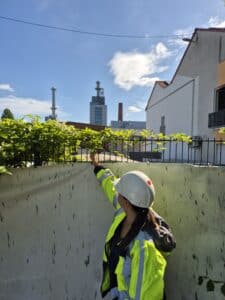
A person wearing high-visibility clothing is working on a metal fence that forms part of a Security Zone. In the background, a facility operated by an Energy Producer is visible.

Security Zone in Public Transportation

A Security Zone Concept identifies which areas of a site require enhanced protection and which security measures are appropriate. For a public transportation parking facility, 3-core GmbH developed a site-specific security concept comprising a current-state assessment, risk analysis, target security zoning plan, and prioritized catalogue of measures.

Initial Situation: An Operational Site with Enhanced Protection Requirements

Parking facilities are critical to day-to-day operations. They bring together vehicles, track infrastructure, technical systems, power supply, pedestrian routes, and adjacent public areas. This creates specific requirements for physical security, access control, perimeter protection, and protective effectiveness.

The operator needed to determine whether the existing security measures were appropriate for the site’s actual protection requirements. Particular attention was given to the perimeter conditions, access points, pedestrian routes, adjacent areas, and sensitive technical functions such as the power supply, technical rooms, and operational infrastructure.

3-core GmbH was commissioned to conduct a structured assessment of the site, evaluate existing vulnerabilities, determine where the establishment of a security zone concept was justified from a security perspective, and identify the measures required as a result.

A security zone is a clearly defined area with specified protection requirements. It defines not only a physical area, but also the applicable requirements for access control, surveillance, protective effectiveness, organizational procedures, and documentation.

The Assignment: Planning Security Where Risks Arise

The objective of the project was to develop a transparent and site-specific security concept based on the assessment of the existing conditions. The security zone was not to be defined uniformly or arbitrarily, but derived from site usage, the threat and risk environment, protection requirements, and the security measures already in place.

The project focused on three key tasks: identifying the applicable requirements, analyzing vulnerabilities, and developing a target security zoning plan with specific recommended measures. The resulting concept was intended to show the operator which areas required enhanced protection, where action was needed, and which priorities should be established.

Site Assessment: Requirements, Documentation, and Site Inspection

At the outset, the 3-core team identified the security-related requirements applicable to the site. These included existing specifications, site information, operational characteristics, and the relevant regulatory framework. The assessment covered, among other aspects, building regulations, fire protection requirements, the KRITIS Umbrella Act, the GDPR, and data protection requirements.

The available documentation was then reviewed and the on-site inspection prepared. This also included the development of a structured interview guide to ensure that the site assessment was conducted systematically and consistently.

During the site inspection, 3-core GmbH focused in particular on:

  • the perimeter and adjacent areas,
  • access points and potential unauthorized entry points,
  • pedestrian routes and circulation areas,
  • existing security measures,
  • identifiable vulnerabilities,
  • track systems and technical infrastructure,
  • power supply systems and technical rooms,
  • specific risks arising from the site’s proximity to publicly accessible transportation areas.

This created a realistic picture of the current security posture, based not only on documentation but also on the actual conditions at the site. The subsequent security zone concept could therefore be derived transparently and traceably from the specific local circumstances.

Risk Analysis: Threat Actor Profiles, Vulnerabilities, and Attack Scenarios

Based on the current-state assessment, the 3-core team analyzed potential threats and vulnerabilities. The risk analysis considered relevant threat actor profiles, attack scenarios, and risks relating to sabotage, intrusion, tampering, and unauthorized access.

The assessment did not focus solely on whether a vulnerability existed. It also evaluated the potential impact of an incident on operations, infrastructure, and security. This provided the basis for determining the required level of protection, the current security posture, and the need for action.

The classification of a security zone is therefore based on several factors: the use of the area, its accessibility, potential threat actor actions, its operational significance, and the existing security measures.

Protection requirements describe the severity of the potential consequences of a security incident. The greater the possible impact on operations, people, infrastructure, or data, the more stringent the requirements for protective measures.

Target Security Zoning Plan: From the Current State to an Appropriate Protection Structure

Based on the analysis, 3-core GmbH developed a site-specific target security zoning plan. The plan was aligned with the existing physical security policy and took account of the specific characteristics of the parking facility.

For each security zone, the required level of protection and the corresponding measures were assessed. This made it possible to differentiate between general operational areas, access-sensitive zones, and technical functions requiring enhanced protection.

The current-state versus target-state analysis identified where existing measures were already adequate and where additional action was required.

Implementation Plan: Balancing Security Effectiveness and Feasibility

Based on the security zoning and the findings of the risk analysis, 3-core GmbH developed specific risk mitigation measures. These measures were not assessed in isolation, but evaluated in terms of proportionality, cost-effectiveness, appropriateness, feasibility, and their contribution to the relevant protection objectives.

A security zone concept is effective only when physical, technical, and organizational security measures are properly aligned. Depending on the area concerned, these may include requirements for perimeter protection, access control, the required level of protection, detection capabilities, organizational procedures, and documentation.

The result was a prioritized implementation framework that provides the operator with clear guidance on which measures should be implemented in the short term and which security-related areas should be developed further over the medium term.

Results Documentation: Risks, Security Zones, and Priorities at a Glance

All findings, assessments, and recommendations were consolidated in a final report. The report included a management summary, a description of the initial situation, the key risks, the security zoning structure, defined security areas, and a prioritized catalogue of measures.

At the conclusion of the project, 3-core GmbH presented the security concept to the relevant stakeholders. Priorities and identified needs for action were explained, feedback was incorporated, and final adjustments were made.

Outcome: A Coherent Protection Framework for the Site

Ultimately, the operator received a site-specific security concept that transparently links the current security posture, the principal threats and hazards, and the defined target state.

The key added value was that each security zone was supported by a sound technical rationale and assigned specific security requirements. This created a robust basis for decision-making: Which areas require enhanced protection? Which measures are appropriate? And which priorities result from the risk analysis, protection requirements, and implementation feasibility?

Our Services for the Project

Requirements Assessment and Document Review

The 3-core GmbH identified the relevant security requirements, reviewed existing policies and specifications, and assessed the applicable regulatory and operational framework conditions.

On-Site Inspection and Current-State Assessment

The 3-core team assessed the perimeter, access points, pedestrian routes, adjacent areas, existing security measures, and identifiable vulnerabilities on site.

Threat and Vulnerability Analysis

3-core GmbH analyzed threat actor profiles, attack scenarios, and risks relating to sabotage, intrusion, tampering, and unauthorized access.

Target Security Zoning Plan and Catalogue of Measures

The 3-core team developed the target security zoning plan, derived specific measures, and prioritized the identified needs for action.

Final Report and Presentation of Results

The findings were consolidated in a final report and presented to the relevant stakeholders. Priorities, identified needs for action, and the next steps were reviewed and aligned jointly.