
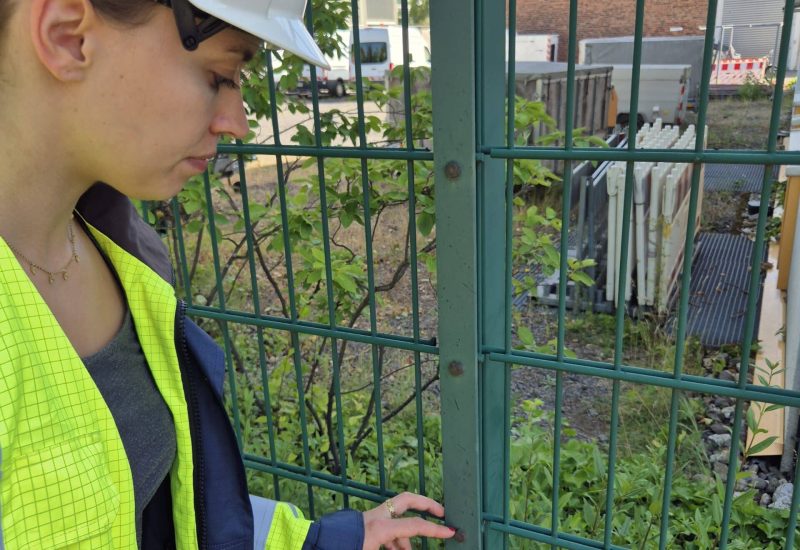
A female employee wearing a black jacket is inspecting a metal fence and the overgrown property boundary in order to identify potential vulnerabilities on the company premises. This on-site assessment forms part of the Security Plan for the manufacturing site.

Security Plan for a Manufacturing Site

A Security Plan must do more than describe individual protective measures. For a sensitive manufacturing site, 3-core GmbH developed a risk-based Security Plan that integrates perimeter protection, detection, video verification, alarm handling, response, and access authorizations into a coherent and traceable security chain.

Initial Situation: An Additional Site with a Different Risk Profile

In a previous project, 3-core GmbH had already assessed one of the client’s particularly sensitive sites and developed a risk-based Security Plan based on the findings. The collaboration was closely coordinated from a technical perspective, and the proven methodology could now be transferred to an additional site.

However, this second site had a different risk profile. It forms part of a larger manufacturing network and primarily performs supporting functions for operations, utilities, and site-specific processes. It was therefore not classified as a highly critical site, but it remained security-relevant: unauthorized access, theft, sabotage, or delayed response could disrupt operations and affect safety, availability, and auditability.

The following aspects were particularly relevant:

  • a directly accessible perimeter,
  • unresolved requirements for perimeter intrusion detection,
  • CCTV planning that had not yet been finalized,
  • unclear alarm handling procedures,
  • insufficiently defined response and intervention processes,
  • the need for a consistent access authorization concept.

The client therefore did not require an oversized high-security model, but a Security Plan aligned with the actual risk profile: effective, transparent, and practicable.

The Assignment: A Security Plan with Clear Priorities

The 3-core was commissioned to conduct a risk-based assessment of the site’s physical security and derive specific recommendations for its further development. The focus was not on producing a generic security document, but on establishing an actionable implementation framework for perimeter protection, detection, video verification, alarm handling, and response.

The client needed to understand which measures should be implemented first, which planning elements required further development, and how the existing security components could be integrated into an effective security chain.

The highest priority was the physical hardening of the perimeter. In parallel, the requirements for detection, CCTV coverage and verification, alarm handling, and response procedures needed to be defined in greater detail. A physical barrier only provides effective intrusion delay if an incident is also detected, assessed, and responded to in a timely manner.

Risk Analysis: Medium Risk, Clear Areas for Action

At the outset, the 3-core team assessed the site’s criticality, operational function, available fallback options, and potential consequences of disruption. The result was a medium risk profile: the site was not classified as highly critical, but several security-relevant vulnerabilities were identified.

The risk analysis focused in particular on organized crime, sabotage, lone actors, and opportunistic acts. These threat actor profiles require different types of security measures. Opportunistic acts can often be deterred through clearly defined boundaries, access control, and visible physical security measures. Organized or premeditated attacks additionally require detection, video verification, and a reliable response chain.

A medium risk rating does not mean that no action is required. It means that security measures must be derived proportionately, not at the maximum level, but in line with the site’s function, relevant threat actor profiles, identified vulnerabilities, and potential impacts.

Tool-Assisted Development: From Risk Profile to Security Plan

To develop the Security Plan, the 3-core team used proprietary assessment and structuring tools. These supported the systematic consolidation of information from the site assessment, criticality assessment, threat actor profile analysis, and vulnerability assessment.

A Security Plan is therefore not based on isolated observations, but on a transparent and traceable assessment. The tools did not replace the professional judgement of the 3-core team; instead, they made it more transparent. Assumptions, risks, vulnerabilities, measures, and priorities could be documented and compared consistently.

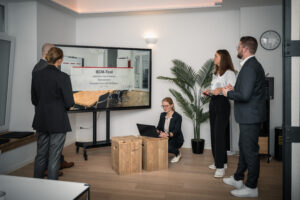
The diagram illustrates the project process in five steps:

  1. Assessment of the Current State
    Documentation of existing measures, outstanding issues, and site-specific conditions.
  2. Development of the Risk Profile Using the Risk Analysis Tool
    Structured assessment of criticality, threat actor profiles, vulnerabilities, and the overall risk level.
  3. Planning of Security Zones and Resistance Times
    Definition of security zones, zone boundaries, and risk-based security requirements.
  4. Preparation of the Security Plan Governance Document
    Translation of the findings into a transparent and traceable framework with a defined logic for security measures.
  5. Presentation of the Security Plan and Implementation Plan
    Review and alignment of the results, followed by the handover of a prioritized implementation plan.
Roadmap to the Security Plan: From the Current-State Assessment and Tool-Assisted Risk Profile to a Prioritized Implementation Plan.

Perimeter Protection as the First Priority

A key focus was the directly accessible perimeter. The 3-core team recommended treating the physical hardening of the perimeter as the first priority. Perimeter protection was not viewed as an isolated measure, but as the starting point of an integrated security chain.

For a Security Plan, simply reinforcing a boundary is not sufficient. The decisive factor is whether that boundary is integrated into a coordinated system of detection, assessment, and response.

Bild26

Resistance time is valuable only if it can be used effectively. If an intrusion attempt is not detected, or if it is unclear who is responsible for responding, even a robust barrier remains no more than an isolated obstacle.

Detection, Video Verification, and Alarm Handling

In addition to physical hardening, detection played a central role. A security barrier can only be effective if security-relevant events are identified at an early stage. The 3-core therefore derived requirements for perimeter intrusion detection, CCTV planning, and video verification.

Video verification enables alarms to be assessed quickly and false alarms to be distinguished from genuine security incidents. It also supports informed decisions on whether a security response must be initiated.

For the site, this meant:

  • security events must be detected at an early stage,
  • alarms must be verifiable,
  • response actions must be initiated through clearly defined procedures,
  • roles and responsibilities must be clearly assigned,
  • incidents must be documented.

This integration is essential to an effective Security Plan: technology alone does not provide security. It must be embedded within clearly defined operational processes.

Response: Establishing Clear Response Procedures

A further focus was the response framework. The project identified a need to clarify outstanding issues relating to alarm handling and incident response. For an effective Security Plan, it is essential to define what happens after an alarm is triggered: Who receives the alarm? Who assesses the situation? Who decides whether escalation is required? Who initiates the operational response?

The 3-core recommended establishing a dedicated, continuously staffed alarm receiving and monitoring centre. This enables alarms to be assessed consistently, response measures to be initiated through clearly defined procedures, and security incidents to be documented in a traceable manner. The Security Plan was therefore designed to be robust not only from a technical perspective, but also at the organizational level.

Security Zoning Concept and Access Authorizations

Based on the risk analysis, the 3-core developed a graduated security zoning concept comprising four security zones. Rather than treating the site as a uniform area, it was divided according to protection requirements, access control requirements, risk profile, and the required resistance time.

The security zones enable measures to be planned in a differentiated manner. Not every area requires the same level of protection. While general areas primarily require clearly defined access rules and baseline protection, more sensitive areas require enhanced perimeter protection, detection, verification, and response capabilities.

In addition, the 3-core recommended implementing a standardized access authorization concept. This establishes clear rules governing who may access which areas, how access rights are granted and revoked, and how external personnel are managed.

A Security Plan is therefore governed not only through physical security measures, but also through clearly defined processes, responsibilities, documentation, and evidence of compliance.

Outcome: A Security Plan with a Clear Implementation Framework

The client ultimately received a site-specific Security Plan with clearly defined priorities. The focus was on physically hardening the perimeter, developing detection and video verification capabilities in parallel, and establishing clearly defined procedures for alarm handling and response.

The result was a security framework aligned with the site’s medium risk profile: effective, transparent, and implementation-oriented. At the same time, the successful collaboration from the previous project was continued and translated into a methodology that can be applied across multiple sites.

Our Services for the Project

Criticality and Risk Assessment

The 3-core assessed the site’s criticality, its role within the corporate structure, and the potential impact of security-related incidents. Based on this assessment, a realistic risk profile was developed to provide the foundation for the subsequent planning of security measures.
Threat Actor Profile Analysis

The 3-core team assessed relevant threat actor profiles, including organized crime, sabotage actors, lone actors, and opportunistic offenders. The objective was to develop realistic threat scenarios and derive corresponding requirements for perimeter protection, detection, video verification, and response.

Vulnerability Analysis

As part of the security assessment, the 3-core identified existing vulnerabilities. Particular attention was given to the directly accessible perimeter, unresolved issues relating to perimeter intrusion detection, CCTV planning, and the processes for alarm handling and response.

Tool-Assisted Risk and Measure Development

The 3-core team used proprietary tools to assess criticality, threat actor profiles, vulnerabilities, and security measures in a structured manner. This enabled the findings to be documented and compared transparently and translated into a prioritized implementation plan.

Development of a Security Zoning Concept

The 3-core developed a graduated security zoning concept comprising four security zones with risk-based resistance times. This enabled protection areas, access requirements, and security measures to be clearly differentiated.

Requirements for Perimeter Protection, Detection, and Video Verification

The 3-core team defined requirements for the physical hardening of the perimeter, the implementation of suitable detection systems, and the integration of video verification. This embedded the site’s outer security layer within a continuous and coordinated security chain.

Response and Alarm Management Framework

The 3-core defined requirements for alarm handling, escalation pathways, and response procedures. A dedicated, continuously staffed alarm receiving and monitoring centre was recommended to ensure that alerts can be assessed reliably and response measures initiated in a clear and traceable manner.

Access Authorization Concept

The 3-core team recommended implementing a standardized access authorization concept. This enables access rights to be clearly defined, documented, and reviewed for both internal personnel and external service providers.

Security Plan with an Implementation Plan

On this basis, the 3-core developed a Security Plan integrating technical, physical, and organizational security measures. This provided the client with a prioritized implementation plan for the next stages of delivery.