
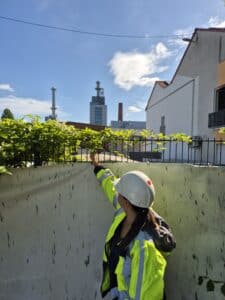
An employee in high-visibility clothing is installing or inspecting the perimeter protection on a metal fence in front of an industrial building.

Perimeter Protection within the concept of security

The 3-core GmbH developed a risk-analysis-based concept of security zoning for a multi-company industrial site. The concept integrated perimeter protection, sensitive areas, access control processes, resistance times, and structural, technical, and organizational measures into a coherent and traceable security framework. The project addressed a site whose legacy security structures needed to be adapted to increasing protection requirements.

Initial Situation: A Site with Multiple User Groups and Sensitive Areas

The client operates a multi-company industrial site comprising manufacturing companies, service providers, technical operating areas, and support functions. Ongoing operations depend on various user groups, including employees, external contractors, maintenance personnel, cleaning staff, logistics providers, inspection services, and other service partners.

At the same time, the site contains areas with elevated protection requirements. These requirements arise not only from individual buildings or installations, but also from the interaction between production, storage, access control, contractor deployment, regulatory requirements, and the strategic importance of specific areas within the site.

Particularly relevant factors included:

  • changing access requirements for internal and external personnel,
  • sensitive zones within a larger industrial site,
  • differing responsibilities across the site,
  • multiple transition points between general-access and protected areas,
  • increasing requirements for documentation, traceability, and protective effectiveness.

The client therefore required more than an isolated package of measures. A risk-analysis-based security concept was needed to identify different protection requirements and translate them into specific security requirements.

The Assignment: From Site Assessment to a Coherent Protection Framework

3-core GmbH was commissioned to conduct a structured assessment of the site’s physical security and to develop a robust security zoning concept based on the findings. The focus was not limited to securing the external perimeter, but primarily concerned how areas with different protection requirements could be appropriately separated from one another.

This first required an understanding of which areas were particularly critical, which user groups moved throughout the site, and which risks needed to be considered realistically as part of the risk analysis. Only on this basis could requirements for zone boundaries, access control, detection, resistance times, and organizational procedures be defined.

The key question was:

How can an established multi-company industrial site be structured so that sensitive areas are adequately protected while maintaining operational capability?

Perimeter Protection as Part of the Site Security Architecture

Perimeter protection refers to the external safeguarding of a site, for example through property boundaries, vehicle entrances, gates, fences, structural barriers, or controlled access points. For a sensitive industrial park, this initial line of defence is essential, but it does not address every security requirement.

Many risks arise within the site itself: at transition points between general operational areas and sensitive zones, through changing access authorizations, contractor movements, or unclear organizational procedures. In this project, perimeter protection was therefore treated as the starting point rather than the final layer of security.

The decisive factor was how effectively protection requirements, threat profiles, resistance times, detection capabilities, and response measures were aligned. The risk analysis therefore formed the basis for developing a concept of security.

Risk Analysis: Who Might Act, and How?

A key component of the project was the threat and risk analysis. The 3-core team assessed relevant threat actor profiles and their potential methods of operation, including opportunistic offenders, lone actors, organized groups, espionage and sabotage actors, as well as activist or disruption-oriented groups.

The objective was to develop realistic scenarios for the site, such as unauthorized access, surveillance or reconnaissance of sensitive areas, disruption of operational processes, or deliberate interference with systems and equipment. The risk analysis provided the basis for determining the required level of protection for specific areas and defining the corresponding requirements for physical security, detection, and response.

Site Inspection and Vulnerability Analysis

Building on the risk analysis, the site’s existing security posture was assessed. During the site inspection, the 3-core team examined, among other aspects, the external security perimeters, vehicle access points, pedestrian entrances, transition points between different areas, structural separations, technical security systems, and organizational procedures.

The assessment did not focus solely on whether security measures were in place. More importantly, it evaluated whether those measures were appropriate for the respective protection requirements. An access control measure may be sufficient for a general operational area, while providing an inadequate level of protection for a sensitive security zone.

LPS 1175 and EN 1627: Making Resistance Requirements Transparent

LPS 1175 and EN 1627 were used to provide a technical framework for assessing physical security requirements. Both standards help make physical resistance more tangible, but they approach the subject from different perspectives.

LPS 1175 evaluates security products and systems from an attack-oriented perspective. It combines tool categories with resistance times: the key considerations are which tools a threat actor might use and how long a security barrier must withstand the attempted breach.

EN 1627, by contrast, defines resistance classes for burglar-resistant building components such as doors, windows, curtain walling, grilles, shutters, and other closures.

Within the project, the two standards were not treated as equivalent. Instead, they were used as technical guidance to derive traceable requirements for zone boundaries, building components, and security perimeters based on the risk analysis, the relevant threat actor profile, and the required resistance time.

The diagram illustrates that the greater the assumed threat actor capability and the more extensive the tools available, the higher the required level of resistance of the security barrier. This applies both to perimeter protection as the site’s outer security layer and to internal security-zone boundaries.

At the same time, detection, alarm notification, verification, and security response must be coordinated so that the delay provided by the barrier can be used effectively. For the security zoning concept, this meant that the decisive factor was not merely whether a boundary existed, but what level of protection it needed to provide in the specific risk analysis scenario.

Diagram showing categories A to H, with increasing tool and attack capabilities and progressively longer resistance times, serving as a basis for perimeter protection analysis.

Transitioning from One Security Zone to the Next

The interfaces between security zones were a particularly important aspect of the risk analysis. Security risks often arise precisely where different areas intersect: at gates, doors, vehicle entrances, security airlocks, technical access points, or organizational interfaces.

For each security-zone boundary, the following questions were assessed:

  • Which employees or service providers are authorized to pass through?
  • What level of access authorization is required?
  • Which physical barrier protects the transition point?
  • What resistance time must be achieved?
  • How is an unauthorized access attempt detected?
  • Who is responsible for responding to an incident?
  • How is the event recorded and documented?

The transition from one security zone to another was therefore not viewed merely as a door, gate, or fence, but as a controlled security process. A higher-level security zone does not simply require more resistant materials. It also requires stricter access-control rules, clearly defined responsibilities, improved documentation and traceability, and the coordinated integration of structural, technical, and organizational security measures.

From Perimeter Protection to a Security Zoning Concept

Based on the risk analysis, the site inspection, and the technical assessment, 3-core GmbH developed a risk-analysis-based security zoning concept. Rather than treating the site as a single uniform area, it was divided into zones with different security requirements.

For each zone, the required level of protection, resistance time, structural security measures, technical detection systems, access control processes, and documentation requirements were assessed.

Perimeter protection was defined as the site’s outer security layer. Its full effectiveness, however, was achieved only through its integration with internal security zones, clearly defined transition points, graduated access rights, and coordinated organizational processes.

Outcome: A Security Concept with Clear Priorities

The client ultimately received a site-specific security concept that integrates physical security, operational capability, and compliance documentation. Sensitive areas were clearly delineated, requirements were defined for each security-zone boundary, and recommended measures were prioritized.

The key benefit was that perimeter protection, security zones, and individual measures were not assessed in isolation, but as components of an integrated security framework. The client can now clearly understand which areas require enhanced protection, which resistance times are necessary, and which structural, technical, or organizational measures are appropriate at each location.

This transformed a complex multi-company industrial site into a structured security framework that addresses elevated protection requirements, positions perimeter protection appropriately within the overall concept, and maintains operational continuity.

Our Services for the Project

Definition of the Scope

The 3-core GmbH first defined and structured the scope of the security concept. This involved determining which site areas, user groups, transition points, and security functions were relevant to the assessment. The result was a clear basis for the subsequent risk analysis and the development of recommended measures.
Risk and Criticality Analysis

The 3-core team assessed the criticality of the site and conducted a risk analysis of relevant hazards and threats, including natural events, technical failures, various threat actor profiles, and risks at country, corporate, and site level.

Threat and Risk Analysis

The 3-core team assessed relevant threat actor profiles, typical methods of operation, likelihood of occurrence, and potential impacts. The objective was not merely to identify abstract risks, but to develop realistic site-specific scenarios and derive concrete requirements for protective effectiveness, detection, and response.

Site Inspection and Vulnerability Analysis

During the site inspection, the external security perimeters, vehicle access points, pedestrian entrances, transition points between different areas, structural protection measures, technical security systems, and organizational processes were assessed. In particular, the 3-core team examined whether the existing measures were appropriate for the respective protection requirements and identified gaps within the overall security framework.

Development of the Security Zoning Concept

3-core GmbH developed a risk-analysis-based security zoning concept that divides the site into areas with different security requirements. For each zone, the required level of protection, zone boundaries, resistance times, access control requirements, and supplementary measures were derived in a transparent and traceable manner.

Application of LPS 1175 and EN 1627

The 3-core team used LPS 1175 and EN 1627 as technical reference frameworks for defining minimum physical security requirements. The standards were not applied generically; instead, they were used to derive traceable protection requirements for security-zone boundaries based on the risk analysis, relevant threat actor profiles, assumed attack tools, and the required resistance time.

Derivation of Structural, Technical, and Organizational Measures

Based on the risk analysis, recommendations were developed across multiple levels. These included structural requirements for security perimeters and transition points, technical requirements for detection and verification, and organizational requirements relating to access control, contractor management, security response, documentation, and evidence of compliance.

Prioritization of Measures

Finally, the 3-core GmbH prioritized the recommended measures. This provided the client with a robust basis for systematically planning short-, medium-, and long-term security measures and for integrating perimeter protection into the overall security framework comprising security zones, access control, detection, resistance time, and organizational governance.